
Laser Cutting of Optical Glass: From the First Lens to the Modern Component
Optics is one of the oldest precision disciplines and one of the most demanding modern ones. A lens that bent light for a 13th-century reader and the waveguide inside a pair of augmented-reality glasses solve the same problem — directing light with precision — separated by seven centuries of method.
What has changed most recently is not the optics. It is how they are made. Grinding and polishing built the field; today a growing share of optical components — in fused silica, sapphire, and borosilicate glass — is cut, drilled, and marked by laser. For prototypes, small batches, and the fast-changing requirements now common in defence and unmanned systems, that shift is decisive.
A short history of optics
The first optical tools were simple. Polished rock-crystal lenses survive from the Assyrian period, and ancient writers described burning glasses that focused sunlight. The science came later: around 1021, Ibn al-Haytham’s Book of Optics set out how light and vision actually work, and remained the foundation for six hundred years.
Practical optics followed. Reading stones gave way to the first spectacles in 13th-century Italy. The telescope appeared in 1608 and the microscope soon after, turning lenses from aids for the eye into instruments of discovery.
The decisive industrial step came in Jena in the 1880s. Otto Schott, working with Ernst Abbe and Carl Zeiss, turned optical glass from a craft into a science — glass formulated to specification rather than found by trial. The company that grew from that work, SCHOTT AG, was later a founding partner of MDI Advanced Processing GmbH. The line runs directly from the birth of modern optical glass to the laser processing of it today.
The last piece arrived in 1960, when Theodore Maiman built the first working laser. It would take decades, but the laser became not only a subject of optics but a tool for making them.
What optics do — then and now
For most of their history, optics served sight and observation: spectacles, telescopes, microscopes, then photographic lenses.
The modern range is far wider. Optical components now sit inside laser systems, fibre-optic networks, medical and industrial sensors, and the waveguides that make augmented-reality glasses work. Mirrors and lenses are no longer only about magnification; they steer, split, filter, and shape beams of light in systems where the optics are a working part, not an accessory. Two fields are growing especially fast: augmented reality, and defence and unmanned systems.
Why laser is now a production option
Optical glass — whether fused silica, sapphire, or borosilicate — has traditionally been shaped by grinding, polishing, and mechanical drilling: precise, but slow, tool-dependent, and poorly suited to prototypes or frequently changing designs. Each new geometry can mean new tooling.
Laser cutting and drilling removes most of that constraint. The same machine that cuts an optical blank can drill it, ablate a coating, and micromachine fine features in it. As MDI’s Managing Director, Dr. Christoph Hermanns, puts it:
“No special tooling — one laser beam and software.”
In practice, that means:
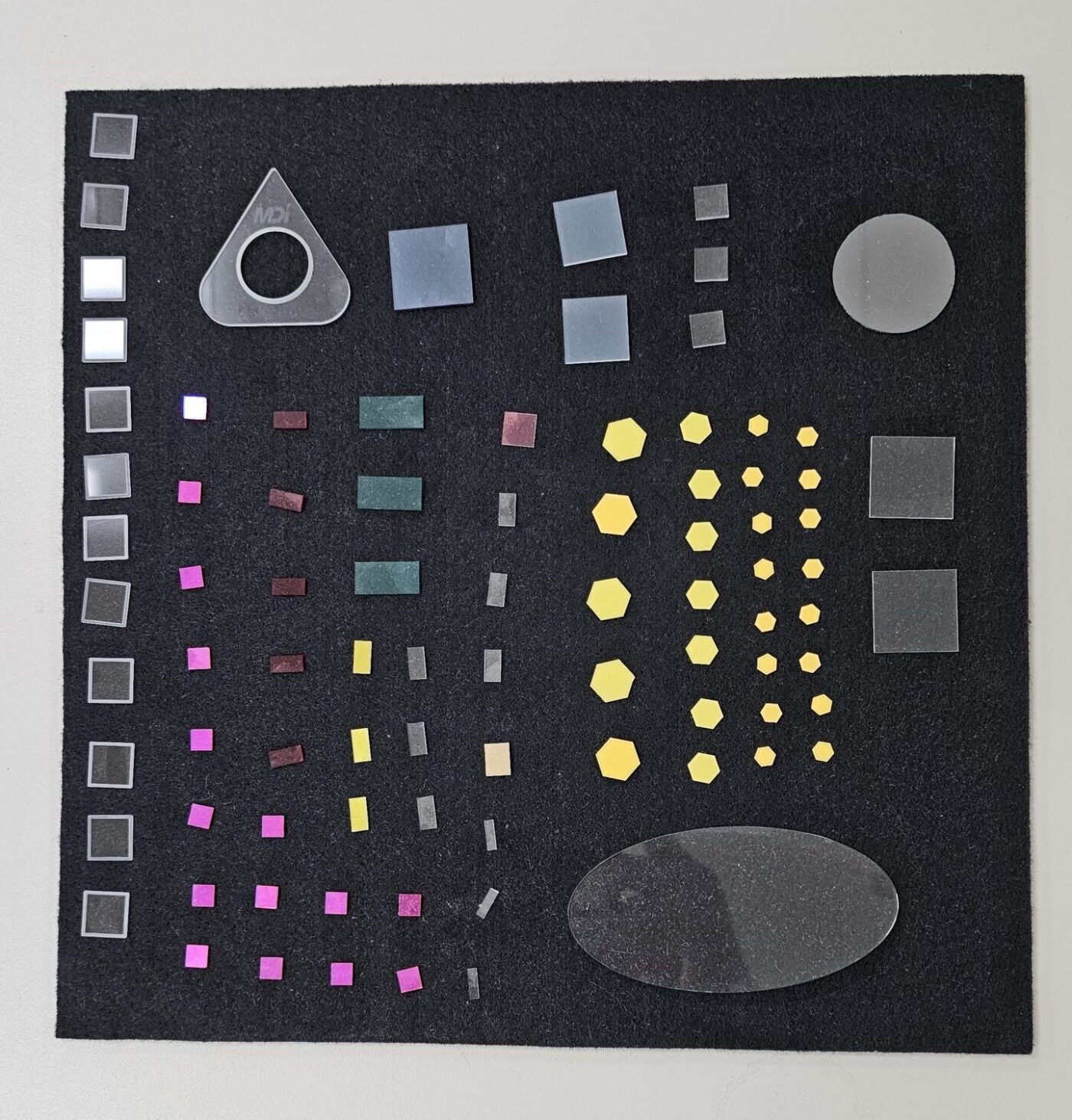
- Almost any geometry. Shapes that would be difficult or impossible to tool can be programmed directly.
- One machine, several operations. Cutting, drilling, coating ablation, and data-matrix codes are produced on the same system.
- Fast prototypes and small batches. No tooling lead-time, so first parts come quickly and design changes cost little.
- Demanding features. Blind holes, internal channels, and microholes down to the smallest bores are achievable.
- No special tooling. One laser beam and software replace a rack of dedicated tools.
For low-to-medium volumes — exactly where optical development and specialised production sit — this changes the economics.
Optics for defence and unmanned systems
Defence programmes and unmanned systems — drones above all — depend on optical components. Imaging and targeting heads, range-finders, beam-steering elements, protective windows (often sapphire or fused silica), and the lenses and mirrors inside sensor assemblies are all optical parts, and modern platforms carry many of them.
The way these parts are ordered fits laser processing closely. Volumes are often low, and batches change frequently as designs iterate. Timelines are tight. Traceability is frequently required — and the same laser that cuts and drills a component can mark it with a permanent data-matrix code in the same step. Geometry freedom, no tooling lead-time, fast iteration, and integrated marking line up with what these programmes actually need.
The same logic extends to augmented-reality optics — including helmet- and head-mounted displays — and to the mirrors and lenses used across optical assemblies.
From prototype to series, without requalification
What matters in optics is not only making one part well, but making the next thousand identically. Every change of supplier, equipment, or process parameter can trigger requalification — costly, and slow.
MDI’s approach is built around removing that break: the same partner, the same equipment, and the same process parameters from the first prototype through to series production. The part qualified in development is the part that ships.
That sits on a long base in glass — more than 90 years of cutting heritage and over 30 years of laser processing. For optical components destined for defence, AR, or precision instruments, development and production become one continuous line rather than two.
MDI runs a laser cutting, drilling, and marking service for optical glass — in effect a glass laser job shop for lenses, mirrors, windows, and custom optical components, from prototype to series. If you are developing an optical part and want to move from first sample to production without re-tooling or requalification, that is where to start. Contact the team directly at sales@mdi-ap.com or +49 6131 7321-0.
Frequently asked questions
Can optical glass be cut by laser?
Yes. Laser cutting is an established production method for optical glass, including free shapes, inside contours, and chamfered edges. Because the process is contactless and needs no dedicated tooling, new geometries are programmed rather than machined.
Can you laser drill fused silica or sapphire?
Yes. Fused silica, sapphire, and borosilicate glass can all be laser drilled — including blind holes, internal channels, and microholes down to very small bores. Drilling, cutting, and marking run on the same machine.
Is laser cutting suitable for prototypes and small series?
It is the strongest use case. With no tooling lead-time, first parts come quickly and design changes cost little. The same equipment and process parameters then carry from prototype into series production, so no requalification is needed.
Can data-matrix codes be marked into glass?
Yes. A permanent data-matrix code can be marked directly into the glass in the same processing step as cutting and drilling — full traceability without an extra operation, which defence and aerospace programmes typically require.