
How to Reduce Glass Chipping: The Engineer’s Guide to Wheel Selection
If you are looking for ways to reduce glass chipping in your production line, understanding the physics of the cut is the first step. In industrial glass processing, edge quality is the ultimate benchmark of production efficiency. Even minor edge chipping creates structural vulnerabilities that lead to high rejection rates and catastrophic breakage during tempering or assembly.
If your facility is struggling with inconsistent yields, the solution rarely lies in the machine alone. Instead, it often comes down to the physics of the cutting wheel geometry.
Why Edge Chipping is a Costly Production Barrier
Chipping is more than a visual defect; it is a sign of uncontrolled stress in the glass. When a cut is suboptimal, it introduces:
- Unstable Break Behavior: The glass “wanders” during the snap, leading to dimensional inaccuracies.
- Reduced Mechanical Strength: Micro-chips act as stress concentrators. As shown in standardized 4-point bending tests, improper wheel selection significantly lowers the stress threshold the glass can withstand before failure.
- Increased Post-Processing Costs: Excessive grinding and polishing are required to “save” the part, eating into your profit margins.
Many production managers find that operators notice chipping in glass cutting even when machine parameters remain unchanged. This usually indicates that the cutting tool is no longer matched to the material tension or has exceeded its effective lifespan.
The Physics of a “Clean” Cut: Median vs. Lateral Cracking
Glass cutting is a process of controlled fracture. A high-quality cutting wheel is designed to create a deep vertical crack (the median crack) while minimizing horizontal cracks (the lateral cracks). Chipping occurs when these lateral cracks reach the surface of the glass.
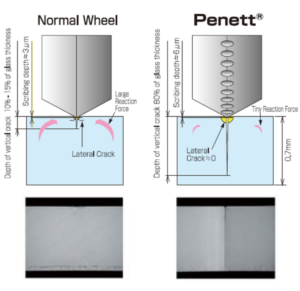
The distribution of stress at the contact point is determined by the interaction between the applied vertical force and the specific geometry of the wheel’s apex. If the wheel design isn’t precisely matched to the glass thickness and tension, the stress intensity exceeds the material’s limits in the wrong direction, causing the edge to splinter rather than score cleanly.
Matching Tools to Reduce Glass Chipping (Penett® vs. APIO®)
Reducing chipping requires selecting a tool geometry that matches your specific glass type and production goals:
1. For High-Precision Scribing: Penett®
Ideal for consumer electronic glass and substrates up to 2mm.
-
Engineering Advantage: The patented notched design is precision-tuned to create the deep vertical cracks required for high-yield separation in thin-glass environments.
-
Technical Note: Penett® is a high-performance specialist designed for peak efficiency on glass thicknesses up to 2mm. By concentrating its energy on deep penetration in these specific ranges, it ensures a stable breaking process where standard tools often struggle.
-
Result: Industry-leading crack depth and stable scribing for the most demanding consumer electronic substrates.
2. For Maximum Edge Quality: APIO®
Engineered for consumer electronic applications where superior edge strength and surface quality are the top priorities, across all relevant glass thicknesses.
-
Engineering Advantage: As an “All Purpose In One” tool, APIO® offers a universal application range. It is designed to provide maximum stability at scribe line crossing points and prevent “slipping,” ensuring a flawless finish whether you are processing thin substrates or thicker industrial glass.
-
Versatility: Unlike specialized tools that focus only on depth, APIO® is optimized for the highest possible bending strength. This makes it the ideal choice for manufacturers who require a broad operational window and consistent, high-quality results across various product lines.
-
Result: Minimal particle generation and unmatched edge integrity for high-performance glass of all thicknesses.
Maintaining Process Stability through Tool Quality
Consistency is the foundation of high-yield glass cutting. Even the most advanced cutting wheels will eventually degrade. As the wheel edge rounds off:
- The scoring depth becomes shallow and inconsistent.
- The machine requires higher pressure to initiate the crack, which inevitably increases chipping.
- The overall process window shrinks, leading to unpredictable downtime.
Consistent tool quality is essential when aiming to reduce chipping in glass cutting processes. Utilizing high-performance materials like diamond or specialized tungsten carbide ensures that the “golden” settings you find on Day 1 are still producing results weeks later.
Conclusion: Engineering a Cleaner Edge
Ultimately, the best way to reduce glass chipping isn’t about trial and error with machine pressure; it’s about controlling crack propagation through superior tool selection. By selecting specialized cutting wheels designed for specific glass types—whether automotive, display, or architectural—you can significantly improve your bottom line.
Optimize Your Production Yield
Don’t let edge chipping compromise your quality standards. MDI’s technical team specializes in custom wheel geometries and high-penetration designs that eliminate rework and stabilize your cutting process.
See the MDI Difference in Your Own Facility
Don’t take our word for it—see the 90% median crack depth for yourself. If you are struggling with edge instability or high scrap rates, we invite you to test our technology on your specific glass substrates.
Request a technical consultation and a Cutting Wheel Sample Kit (including Penett® or APIO® options) to compare our edge quality against your current production standard.
Request a Technical Consultation or Get a Cutting Wheel Sample Kit